Spatial field inference (SPDE)
Experimental
The SPDE toolbox is functional but experimental in this release:
its API may change, and only the linear estimators
(infer_force_linear(), infer_diffusion_linear()) are validated on
grid layouts.
When your data lives on a regular grid — concentration fields, density maps, velocity grids, microscopy images — the force to infer is a functional of the field, typically expressed through spatial differential operators (Laplacians, gradients, etc.). SFI’s SPDE toolbox provides:
Composable stencil operators —
Laplacian,Gradient,Biharmonic,LaplacianOfGradientSquared,Divergence,Curl,SymGrad,SkewGrad, andAdvectionBy— that you apply to any pointwise expression of the fields. Operators can be composed (e.g.Div(Grad(phi))), automatically fusing their stencils via Minkowski-sum offset arithmetic.Grid-aware noise models — conserved (divergence-form) and composite noise for simulation and inference.
Full integration with SFI’s basis algebra, sparsification, and Langevin simulation pipeline.
Conceptual picture
An SPDE on a regular grid with field \(\phi(\mathbf{r}, t)\) takes the general form
where \(i\) runs over grid sites, \(\mathcal{F}\) is a (typically nonlinear) functional of the field, and \(\eta\) is spatiotemporal noise.
SFI treats each grid site as a particle and each field component as a coordinate. Spatial derivatives become structural interactions between neighbouring sites, computed via finite-difference stencils.
Key idea
You never write stencil code yourself. Instead, you compose differential operators with pointwise field expressions using Python’s standard arithmetic syntax. SFI handles the rest: stencil dispatch, boundary conditions, JIT compilation, and GPU acceleration.
Grid conventions
Grid index |
Flattened index |
Field components |
One or more scalar fields per site (e.g. |
Spatial coordinates |
Implicit — reconstructed from |
Use square_grid_extras() to create the extras:
from SFI.bases.spde import square_grid_extras

extras = square_grid_extras(grid_shape=(64, 64), dx=1.0)
Composable operators
All differential operators inherit from StencilOp
and share the same interface:
Op = Laplacian(ndim=2, bc="pbc")  # create the operator
lap_phi = Op(phi)                  # apply to a StateExpr
The inner expression phi can be any pointwise state expression:
a field component, a power, a product, or any algebraic combination.
Operator catalogue
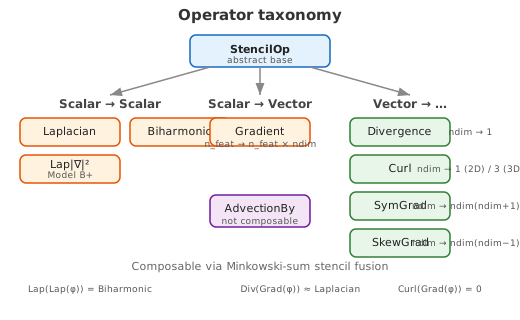
Hierarchy of composable SPDE operators.
Operator |
Symbol |
Notes |
|---|---|---|
\(\nabla^2 f(\phi)\) |
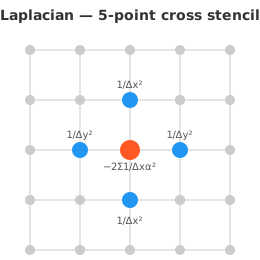
Cross stencil, any dimension. Conservative on PBC. |
|
\(\nabla f(\phi)\) |
Central differences. Output has |
|
\(\nabla^4 f(\phi)\) |
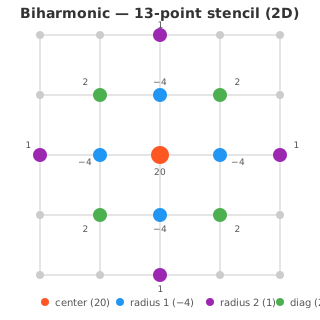
13-point (2D) or 25-point (3D) stencil. |
|
\(\nabla^2|\nabla f(\phi)|^2\) |
The Active Model B+ term. |
|
\(\nabla\!\cdot\!\mathbf{v}\) |
Takes a vector-valued expression ( |
|
\(\nabla\times\mathbf{v}\) |
2D → scalar (z-component); 3D → 3-component vector. |
|
\(\tfrac{1}{2}(\nabla\mathbf{v}+\nabla\mathbf{v}^\top)\) |
Symmetric gradient (strain rate / strain tensor). Output has
|
|
\(\tfrac{1}{2}(\nabla\mathbf{v}-\nabla\mathbf{v}^\top)\) |
Antisymmetric gradient (vorticity tensor). Output has
|
|
\(\mathbf{u}\cdot\nabla f(\phi)\) |
Advection of \(f(\phi)\) by a given velocity expression \(\mathbf{u}\). Not composable (references external state). |
Boundary conditions
Two boundary conditions are supported via the bc parameter:
"pbc"— periodic boundary conditions. Operators wrap around. All operators are exactly conservative: \(\sum_i \text{Op}[g]_i = 0\) for any function \(g\)."noflux"— reflecting (Neumann-like) boundary. Out-of-bounds neighbours are replaced by the focal site’s value, implementing a zero-normal-gradient condition.
Applying operators to expressions
The simplest usage applies an operator to a single field component:
from SFI.bases import field_component
from SFI.bases.spde import Laplacian

phi = field_component(0, n_fields=1)
Lap = Laplacian(ndim=2, bc="pbc")

lap_phi = Lap(phi)          # ∇²φ — a scalar Basis
You can compose operators with nonlinear expressions of the field. The operator evaluates the inner expression at each stencil point first, then applies the finite-difference formula:
lap_phi3 = Lap(phi**3) # ∇²(φ³) — exactly conservative on PBC
Conservation guarantee
Because the Laplacian stencil has zero column sums on periodic grids, \(\sum_i [\nabla^2 g(\phi)]_i = 0\) for any function \(g\). This holds for the Biharmonic and LaplacianOfGradientSquared operators as well.
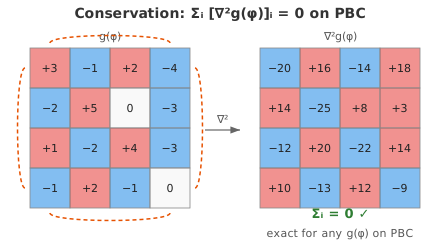
Applying \(\nabla^2\) to any field on a periodic grid always yields values that sum to exactly zero.
Building multi-field models
For multi-field systems (e.g. Gray-Scott with U and V), build per-field operator terms and combine them with the basis algebra:
from SFI.bases import unit_vector_basis
from SFI.bases import field_component
from SFI.bases.spde import Laplacian

Lap = Laplacian(ndim=2, bc="pbc")
U = field_component(0, n_fields=2)
V = field_component(1, n_fields=2)

eU = unit_vector_basis(dim=2, axes=[0])
eV = unit_vector_basis(dim=2, axes=[1])

# ∇²U along the U component, ∇²V along V
drift = Lap(U) * eU & Lap(V) * eV
# → rank-1 Basis with 2 features, acting on (P, 2) state
The * and & operators are the standard SFI basis algebra
(see Building bases):
A * B— tensor product (multiply outputs pointwise)A & B— concatenation (stack features)
Operator composition
Composable operators can be nested: the outer operator automatically detects that its argument already carries stencil metadata and fuses the two stencils into a single wider-radius kernel via Minkowski-sum offset arithmetic.
from SFI.bases.spde import Laplacian, Gradient, Divergence

Lap = Laplacian(ndim=2, bc="pbc")
Grad = Gradient(ndim=2, bc="pbc")
Div = Divergence(ndim=2, bc="pbc")

phi = field_component(0, n_fields=1)

# Laplacian of Laplacian — equivalent to Biharmonic
biharm = Lap(Lap(phi))

# Divergence of Gradient — another Laplacian approximation
lap2 = Div(Grad(phi))
The fused stencils visit more neighbours (larger radius) but require
only one call to _dispatch_stencil_operator. All boundary
conditions and conservation guarantees are preserved.
Composition limitation
AdvectionBy is not composable because
it depends on an external velocity expression. Attempting to pass
its result into another stencil operator raises ValueError.
Vector-field operators
Several operators act on vector-valued expressions (fields with
ndim features per scalar field). Use
vector_field() to build the standard coordinate
vector field:
from SFI.bases.spde import Divergence, Curl, SymGrad, vector_field

v = vector_field(n_fields=2)   # (v_x, v_y) for each field

Div = Divergence(ndim=2, bc="pbc")
div_v = Div(v)          # scalar: ∂v_x/∂x + ∂v_y/∂y

C = Curl(ndim=2, bc="pbc")
curl_v = C(v)           # scalar in 2D: ∂v_y/∂x − ∂v_x/∂y

S = SymGrad(ndim=2, bc="pbc")
strain = S(v)           # 3 Voigt components: εxx, εyy, εxy
These operators work on any vector-valued expression, not only the
coordinate-identity vector field. For instance, you can compute the
divergence of a nonlinear flux phi * v.
Stencil visualisation
Every StencilOp instance has a
visualize_stencil() method that prints
an ASCII representation of the stencil offsets:
Lap = Laplacian(ndim=2, bc="pbc")
print(Lap.visualize_stencil())
# .  *  .
# *  @  *
# .  *  .
The diagrams below show the stencil footprints for the two main operators:
Noise models
SPDE integration requires a noise model compatible with the physics.
SFI provides two specialised models in SFI.langevin.noise:
Conserved noise
ConservedNoise implements divergence-form
noise \(\eta = \nabla\cdot(\sigma\,\vec\Lambda)\), where
\(\vec\Lambda\) is white vector noise. The spatial average is
exactly zero at every time step — required for mass-conserving
dynamics like Cahn-Hilliard or Model B.
from SFI.bases.spde import conserved_noise_pbc

noise = conserved_noise_pbc(sigma=0.3, grid_shape=(64, 64), dx=1.0)
The factory conserved_noise_pbc() is a convenience
wrapper around ConservedNoise.
Composite noise
When different fields have different noise character (e.g. conserved
concentration + non-conserved velocity), use
CompositeNoise:
from SFI.langevin.noise import ConservedNoise, WhiteNoise, CompositeNoise

conserved = ConservedNoise(sigma=0.3, grid_shape=(64, 64), n_fields=1)
white = WhiteNoise(sigma=0.1, n_fields=1)
noise = CompositeNoise(
    components=[(conserved, [0]), (white, [1])],
    n_fields=2,
)
Step-by-step example: 1D stochastic heat equation
Let’s infer the diffusion coefficient of a 1D field evolving as
with periodic boundary conditions and white noise.
1. Define the model and generate data
import jax.numpy as jnp
from jax import random
from SFI.bases import field_component
from SFI.bases.spde import Laplacian, square_grid_extras
from SFI.bases import unit_vector_basis
from SFI.langevin import OverdampedProcess
from SFI.langevin.noise import WhiteNoise

# Grid
Nx, dx, dt = 128, 0.5, 0.01
D_true = 2.0
sigma = 0.5

# Basis: force = D * ∇²φ, lifted to a 1-component vector field
# (the process expects a rank-1 force)
Lap = Laplacian(ndim=1, bc="pbc")
phi = field_component(0, n_fields=1)
F_basis = Lap(phi) * unit_vector_basis(dim=1)

# Noise
noise = WhiteNoise(sigma=sigma, n_fields=1)

# Build process
proc = OverdampedProcess(F_basis, D=noise)
proc.set_params(theta_F=jnp.array([D_true]))
proc.set_extras(extras_global=square_grid_extras(grid_shape=(Nx,), dx=dx))

# Initial condition: random smooth field
key = random.PRNGKey(42)
x0 = 0.5 * jnp.sin(2 * jnp.pi * jnp.arange(Nx) * dx / (Nx * dx))
proc.initialize(x0[:, None])   # shape (P, 1)

# Simulate
coll = proc.simulate(dt=dt, Nsteps=5000, key=key,
                      prerun=500, oversampling=10)
2. Infer the diffusion coefficient
from SFI import OverdampedLangevinInference

inf = OverdampedLangevinInference(coll)
inf.compute_diffusion_constant(method="WeakNoise")
inf.infer_force_linear(F_basis, M_mode="Ito")

D_inferred = float(inf.force_coefficients[0])
print(f"True D = {D_true:.2f},  Inferred D = {D_inferred:.2f}")
The linear regression recovers D in a single pass — no iteration, no initial guess.
3. Validate
You can further validate by simulating from the inferred model and comparing spatial correlation functions or power spectra. See the Gallery for full worked examples including the Gray-Scott demonstration.
Multi-field example: reaction-diffusion
A two-field reaction-diffusion system (Gray-Scott-like) with conserved noise illustrates the full workflow:
from SFI.bases import ones_basis, unit_vector_basis
from SFI.bases import field_component
from SFI.bases.spde import Laplacian, conserved_noise_pbc

DIM = 2  # two fields: U, V
Lap = Laplacian(ndim=2, bc="pbc")

U = field_component(0, n_fields=DIM)
V = field_component(1, n_fields=DIM)
eU = unit_vector_basis(dim=DIM, axes=[0])
eV = unit_vector_basis(dim=DIM, axes=[1])
one = ones_basis(dim=DIM)

# Diffusion: D_U ∇²U + D_V ∇²V
# Reaction:  -U*V² + F*(1-U) for U,  +U*V² - (F+K)*V for V
drift = (
      Lap(U) * eU           # D_U ∇²U
    & Lap(V) * eV           # D_V ∇²V
    & (U * V**2) * eU       # −UV² (U component)
    & (U * V**2) * eV       # +UV² (V component)
    & one * eU              # F constant (U component)
    & U * eU                # −FU (U component)
    & V * eV                # −(F+K)V (V component)
)
The inference then works identically to the scalar case:
inf = OverdampedLangevinInference(coll)
inf.compute_diffusion_constant(method="WeakNoise")
inf.infer_force_linear(drift, M_mode="Ito")
print("Inferred coefficients:", inf.force_coefficients)
Active nematic example
Active nematics provide a rich showcase for the same-space vector operators. Consider a 2D nematic whose dynamics are governed by a director field \(\mathbf{n}(\mathbf{r}, t)\) (unit vector) and a flow field \(\mathbf{v}(\mathbf{r}, t)\). The force balance and nematic order parameter evolve through terms involving strain rate, vorticity, and divergence.
SFI can express the full tensor algebra of such a system:
from SFI.bases import field_component, x_coordinates
from SFI.bases import unit_vector_basis, ones_basis
from SFI.bases.spde import (
    Laplacian, Divergence, SymGrad, SkewGrad,
    AdvectionBy, vector_field,
)

# State: (vx, vy, nx, ny) → n_fields = 4
vx = field_component(0, n_fields=4)
vy = field_component(1, n_fields=4)
nx = field_component(2, n_fields=4)
ny = field_component(3, n_fields=4)

# Unit vectors for embedding into the 4-field state
e_vx = unit_vector_basis(dim=4, axes=[0])
e_vy = unit_vector_basis(dim=4, axes=[1])
e_nx = unit_vector_basis(dim=4, axes=[2])
e_ny = unit_vector_basis(dim=4, axes=[3])

Lap = Laplacian(ndim=2, bc="pbc")
Div = Divergence(ndim=2, bc="pbc")
SG  = SymGrad(ndim=2, bc="pbc")
W   = SkewGrad(ndim=2, bc="pbc")

# --- Flow equation terms ---
# Viscous stress: η ∇²v
viscous = Lap(vx) * e_vx & Lap(vy) * e_vy

# Pressure (from incompressibility): ∇·v = 0 enforced weakly
# Velocity sub-vector (vx, vy) of the 4-field state — n_features == ndim == 2,
# as required by Divergence / SymGrad / AdvectionBy.
v_vec = x_coordinates([0, 1], dim=4, labels=["vx", "vy"])

# Strain rate: S_ij = ½(∂v_i/∂x_j + ∂v_j/∂x_i)
# → 3 Voigt components: S_00, S_01, S_11
# These can couple to nematic order via active stress

# --- Director equation terms ---
# Elastic relaxation: K ∇²n
elastic = Lap(nx) * e_nx & Lap(ny) * e_ny

# Advection: (v · ∇)n  — advect by the velocity sub-vector v_vec
Adv = AdvectionBy(v_vec, ndim=2, bc="pbc")
advect_nx = Adv(nx) * e_nx
advect_ny = Adv(ny) * e_ny

# --- Full drift basis ---
# Each & concatenation adds a coefficient to the linear regression.
drift = (
      viscous                       # η ∇²v
    & elastic                        # K ∇²n
    & advect_nx & advect_ny          # flow alignment
    & (nx * ny) * e_vx               # active stress coupling
    & (nx**2 - ny**2) * e_vy         # active stress coupling
)
The inference machinery handles the rest:
from SFI import OverdampedLangevinInference

inf = OverdampedLangevinInference(collection)
inf.compute_diffusion_constant(method="WeakNoise")
inf.infer_force_linear(drift, M_mode="Ito")
# inf.force_coefficients contains: [η, K, λ_adv_x, λ_adv_y, ζ_active, ...]
This example illustrates how SymGrad and
SkewGrad extract the symmetric and
antisymmetric parts of the velocity gradient tensor — the strain rate
and vorticity — which couple to nematic order in liquid-crystal
hydrodynamics. All terms are expressed as composable stencil operators
and pointwise expressions; no manual finite-difference code is needed.
Extending the operator catalogue
All composable operators inherit from StencilOp.
To add a new operator:
Subclass
StencilOp.Implement
_offsets()→ stencil offset array.Implement
_build_local_fn(inner_root, *, n_features_out)→ the local finite-difference formula.Optionally override
_n_features_out()if output features differ from input features (as for Gradient).
See the source of Gradient for a clean example.
See also
SPDE API reference — full API documentation for all SPDE classes and functions.
Building bases — basis algebra (
*,&,field_component(),unit_vector_basis()).Choosing a basis — guidance on choosing a basis for your problem.
Physics Reference — mathematical background on the discrete Laplacian and stencil operators.
Simulation — Langevin simulation pipeline.