Gallery
SFI examples gallery. Each script demonstrates a complete inference pipeline: simulate (or load) data, infer forces and diffusion, and validate the results. Use the tag bar above the thumbnails to filter examples by topic.
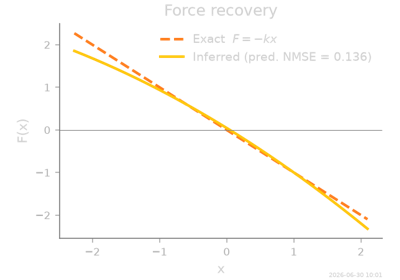
Getting started: end-to-end inference (Ornstein–Uhlenbeck)
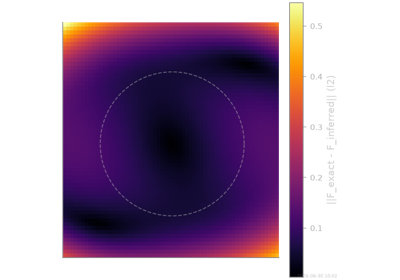
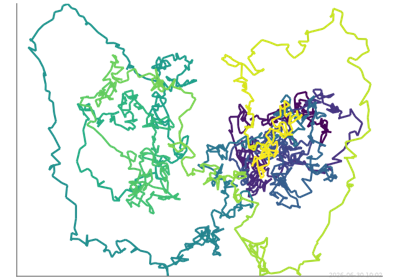
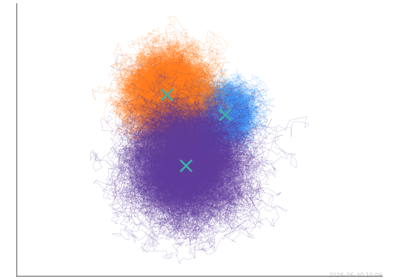
Noise-driven Lorenz system — hopping between two foci
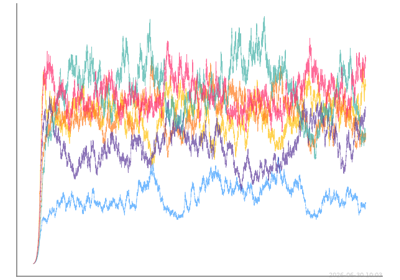
Lotka–Volterra ecosystem — a food web from a few noisy censuses
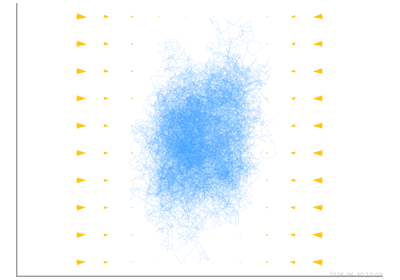
Custom basis with extras — traps in measured light fields
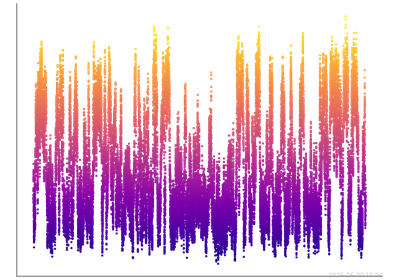
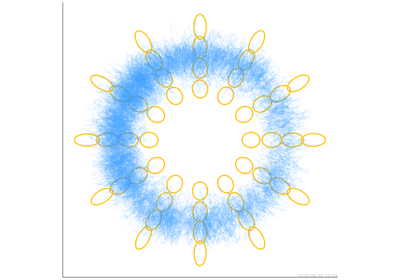
Velocity-dependent noise — underdamped multiplicative diffusion
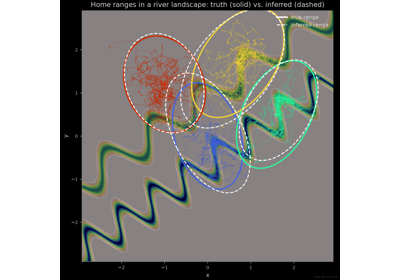
Home ranges in a shared landscape, from noisy gappy data
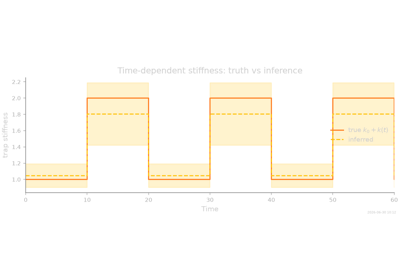
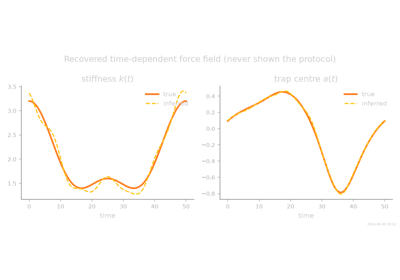
Learning a time-dependent force field — time-Fourier basis
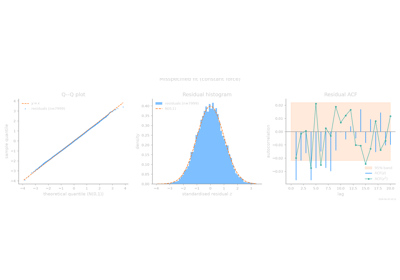
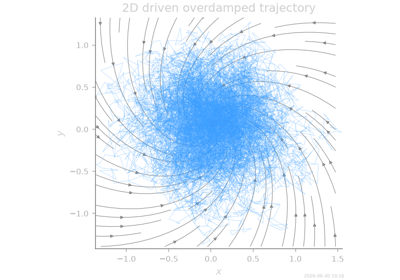
Overdamped or underdamped? Classifying dynamics from data

Measuring dissipation: entropy production in a driven optical trap

Inertial dissipation: entropy production from positions only
Aligning active Brownian particles — interaction kernels from noisy tracks
Nonreciprocal active particles at scale — 10 000 particles

Janus colloids — learning general pair interactions from experimental tracks
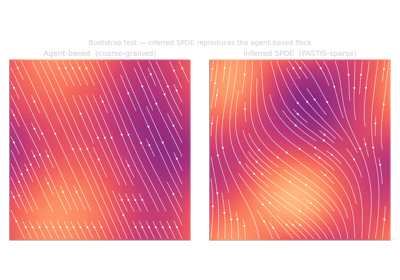
Discovering Toner–Tu hydrodynamics from agent-based flocking
Advanced
These examples combine several tools at once: neural-network energy landscapes, joint fits across experiments with shared and experiment-specific parameters, and underdamped multi-particle systems. Start with the main gallery above if you are new to SFI; the regime table in the Running-inference guide tells you when these tools are the right choice.
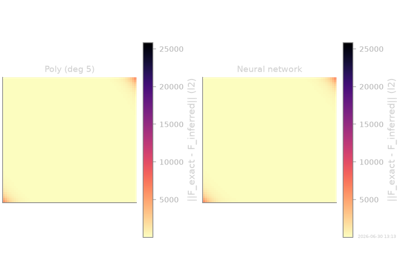
Neural-network energy landscape — Müller–Brown potential
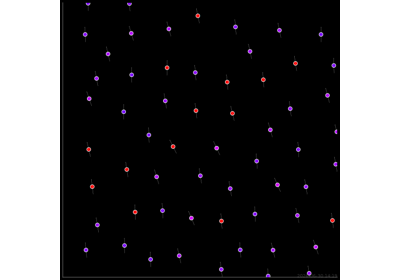
Multi-experiment ABP inference — shared interactions, per-condition motility
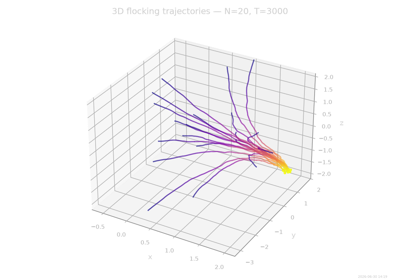
3D milling school — the interaction rules of 200 swimmers